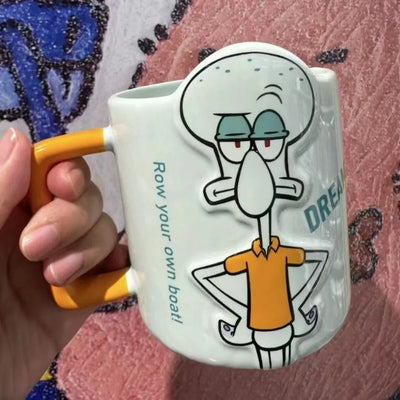
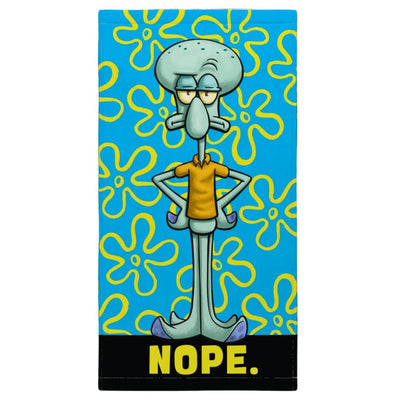
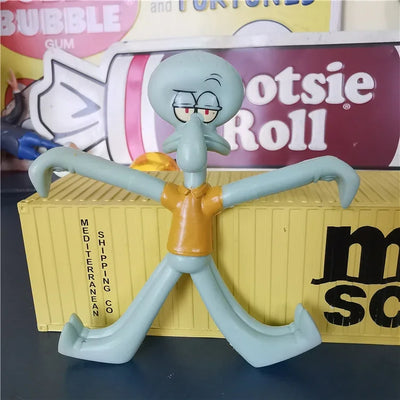
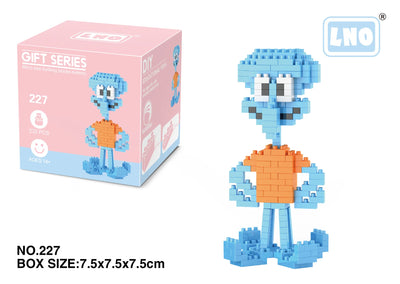
He plays clarinet terribly, paints self-portraits nobody wants to buy, and spends his days lamenting that he lives next to SpongeBob SquarePants. Yet Squidward Tentacles is far more than a simple grumpy neighbor: he is one of the most complex, funniest, and — dare we say it — most touching characters in the entire series.
His love-hate relationship with SpongeBob is at the heart of some of the show's best episodes. But who is Squidward really, behind the arrogance and narcissism? Let's dive into the world of Bikini Bottom's most misunderstood artist, and find out why millions of fans see themselves in him.
📋 Table of Contents
- Profile: Who is Squidward Tentacles?
- An Endearing Narcissism
- Squidward the Artist: Clarinet, Dance, and Painting
- The Love-Hate Relationship with SpongeBob
- His Life at the Krusty Krab
- His Moai Head House
- His Most Iconic Moments
- Squidward's Hidden Heart
- The Character's Evolution
- Our Squidward Tentacles Collection
- FAQ
🐙 Character Profile: Who is Squidward Tentacles?
📊 Squidward Tentacles — Full Profile
| Full name | Squidward Q. Tentacles |
| Species | Octopus — despite his name and 6 tentacles |
| Home | 122 Conch Street — Moai head-shaped house |
| Occupation | Cashier at the Krusty Krab (a position he deeply despises) |
| Passion | Clarinet, painting (self-portraits), contemporary dance |
| Neighbors | SpongeBob SquarePants (right) and Patrick (left) — his nightmare |
| Dream | Become a recognized artist and live far from his neighbors |
| First appearance | May 1, 1999 — Episode "Help Wanted" |
| Original voice | Rodger Bumpass (English VO) |
💡 Did you know?
Despite his name "Tentacles" and his octopus-like appearance, Squidward technically has 6 limbs, not 8. Stephen Hillenburg confirmed he is a stylized octopus for animation purposes, and that the name Squidward referenced the instrument rather than marine biology.

😤 An Endearing Narcissism
Arrogance as a defense mechanism
Squidward is convinced he's a misunderstood genius. He dresses elegantly, speaks condescendingly, and considers virtually all of Bikini Bottom's residents to be intellectually beneath him. This arrogance is both his funniest characteristic and, at its core, the sign of profound artistic insecurity.
Because the painful truth Squidward refuses to admit is that his talent doesn't match his ambition. He plays clarinet terribly (Bikini Bottom's residents literally flee when they hear him), his paintings find no buyers, and his dancing leaves audiences baffled. His grandiosity is a shield against the reality of ordinary talent.
A cynicism that hides sensitivity
Behind his air of superiority, Squidward is deeply sensitive. He feels things intensely — artistic failures break him, rare moments of success transport him with joy. This hidden sensitivity is what makes the character so human. Many adults identify with Squidward: with that feeling of being destined for something great, stuck in a reality too small. Discover all the characters that make Bikini Bottom so rich on our dedicated characters page.
🎨 Squidward the Artist: Clarinet, Dance, and Painting
The clarinet: his passion and his torment
The clarinet is Squidward's instrument of choice and his total obsession. He rehearses for hours in his house, inflicting on his neighbors sounds that send the fish fleeing. The series' recurring joke is that Squidward passionately believes in his talent as a clarinetist while everyone around him suffers through his playing.
But the episode Band Geeks brings an extraordinary nuance: when Squidward conducts the Bikini Bottom orchestra and Sweet Victory rings out at the Super Bowl, we realize he is capable of true greatness — given the right context. It's one of the most memorable moments in the entire series.
Painting: endless self-portraits
Squidward paints exclusively self-portraits. His house is covered in representations of himself in every imaginable style and form. This narcissistic fixation is a recurring source of comedy, but it also reveals a truth: Squidward locks himself in his own inner world, unable to see beyond himself. His paintings never sell, which feeds his bitterness toward a world he considers incapable of appreciating genius.
Dance: the misunderstood art
Squidward also practices contemporary dance with the same enthusiasm and questionable talent. In the episode "The Talent Show", his dance performances provoke mixed reactions. But in "Best Day Ever", he demonstrates that beneath the layers of arrogance lies a genuine desire for authentic artistic expression.
💛 The Love-Hate Relationship with SpongeBob
Irritation as a love language
The relationship between Squidward and SpongeBob SquarePants is one of the richest dynamics in the series. Squidward claims to hate SpongeBob, finds him annoying, loud, and intrusive. He makes repeated attempts to avoid him or silence him. And yet, episode after episode, something deeper shines through.
SpongeBob sincerely admires Squidward and considers him one of his best friends after Patrick. This one-sided admiration is both funny and touching. SpongeBob doesn't perceive Squidward's hostility — or rather, he chooses not to, maintaining undying optimism in this one-sided friendship.
Moments when Squidward admits his affection
Several episodes break through Squidward's wall of indifference. In "Band Geeks", when SpongeBob and the others give everything they have for Squidward's concert, the emotion overcomes all past tensions. In "Are You Happy Now?", the series explores Squidward's artistic depression — and SpongeBob stays by his side without ever giving up. These moments reveal that beneath Squidward's irritation lies genuine affection for SpongeBob.
"These fools have given me what I've always been searching for... Perhaps I always had what I needed, right here in Bikini Bottom."
— Squidward Tentacles, Band Geeks
🍔 His Life at the Krusty Krab
Squidward is the cashier at the Krusty Krab — a position he fills with the bare minimum of required enthusiasm. He responds to customers with mechanical politeness when in a good mood, and barely concealed impatience the rest of the time. His only permanent coworker is SpongeBob, whose overflowing enthusiasm makes working days particularly exhausting for Squidward.
The Krusty Krab cash register symbolizes everything Squidward wants to escape: mediocrity, routine, service to others. Working under Mr. Krabs, who thinks only about money, adds another layer of humiliation to his situation. And yet, Squidward is always there the next morning.
🗿 His Moai Head House
Squidward's house is a giant Moai head — those monumental statues from Easter Island. This architectural choice says a lot about the character: Squidward sees himself as a monumental, ancient, and mysterious figure. The interior of his house matches his personality: refined, filled with self-portraits, with spaces dedicated to musical and artistic practice.
Wedged between SpongeBob's pineapple house and Patrick's rock, Squidward's Moai head symbolizes his voluntary isolation and his disconnect from his neighbors. He has done everything to create a bubble of elegance and culture in a neighborhood he considers vulgar.
🎬 His Most Iconic Moments
Sweet Victory in Band Geeks
The climax of Band Geeks, where Squidward conducts his orchestra of totally incompetent neighbors who deliver an epic stadium performance, is without doubt the most cathartic moment in the entire series. Squidward's visible joy — he who never shows his emotions — is overwhelming. It's proof that beneath all the cynicism hides a man who sincerely yearns for beauty.
Failed attempts to move away
Several episodes show Squidward attempting to escape Bikini Bottom — and SpongeBob. In each episode, fate invariably brings him back to his Moai house and his neighbors. This impossibility of escape is both tragic and comic: Squidward is bound to Bikini Bottom not by force, but by something deeper he refuses to admit.
🎭 Fun fact
Squidward has never won Employee of the Month at the Krusty Krab. SpongeBob has won it 374 times in a row. This seemingly minor detail is at the core of Squidward's chronic frustration.
💛 Squidward's Hidden Heart
What makes Squidward a truly remarkable character is that the series never presents him as a villain. He is cynical, self-centered, and sometimes cruel in his words — but he is never malicious. When SpongeBob is in danger, Squidward steps in. When SpongeBob is sad, Squidward — even against his will — tries to make things right.
For adults watching the series, Squidward represents something deeply relatable: the person who has bigger dreams than their means, who compensates for their frustration with arrogance, but who deep down truly cares about the bonds they pretend to despise. He's the adult in all of us. To explore why SpongeBob resonates so strongly with adults, read our article on SpongeBob as seen by adults.
📈 The Character's Evolution
In the early seasons, Squidward was more of a foil — present to suffer through SpongeBob and Patrick's antics. From season 3 onward, he became a fully-fledged character in his own right, with his own story arcs, dreams, and artistic losses. Episodes like "Are You Happy Now?" (which addresses depression in a surprisingly direct way for a cartoon) show that the creators took Squidward seriously.
This evolution also mirrors the show's own history. To better understand how SpongeBob evolved over 25 years, check out our article on the complete history of the series.
🛒 Our Squidward Tentacles Collection
Join Team Squidward and show your solidarity with Bikini Bottom's most misunderstood artist!
To learn more about the SpongeBob universe, visit the history of SpongeBob on our site.
❓ FAQ — Squidward Tentacles
❓ Is Squidward really an octopus or a squid?
Despite his name, Squidward is technically an octopus. He has only 6 limbs instead of 8 for animation purposes. Stephen Hillenburg confirmed this in interviews. His name "Squidward" (from "squid") is misleading — it's one of the show's intentional paradoxes.
❓ Has Squidward ever experienced artistic success?
Yes, occasionally! In a few episodes, Squidward enjoys brief moments of artistic glory — notably when recognized for his dance or clarinet performances in particular contexts. But the show's fate dictates that these successes are always short-lived, sending Squidward back to his usual frustration.
❓ Why is Squidward so popular despite his difficult character?
Because Squidward embodies a very human frustration: the aspiration to greatness while stuck in the ordinary. Adults identify with him particularly strongly. His narcissism is so exaggerated it becomes touching, and his genuine moments of vulnerability create a strong emotional connection with viewers.
❓ Does a spin-off exist with Squidward as the main character?
No dedicated Squidward spin-off exists to date, unlike Patrick and SpongeBob who have their own series. However, Squidward appears in many episodes centered on his artistic journey, which constitute their own self-contained mini story arcs.
❓ Does Squidward really like SpongeBob deep down?
All evidence suggests yes, even if Squidward would never admit it directly. Several key episodes show Squidward defending SpongeBob, helping him when he's in danger, and even crying with joy at moments of collective victory. The Band Geeks episode is the best example: Squidward doesn't create that orchestra just for himself — in the end, he does it for everyone, SpongeBob included.
📚 Articles You Might Also Like
🛒 Our SpongeBob Collection
Bundle Box Fan Junior | Bundle Box Fan Ultime | SpongeBob Figure - Squidward Articulated | LEGO Nanobloc SpongeBob Figure - Bob