Mermaid Man and Barnacle Boy are two retired undersea superheroes living in Bikini Bottom, and they are the absolute idols of SpongeBob and Patrick. The duo is a parody of 1960s television crimefighters: the costume, the secret lair and the grand heroic declarations are all there, but the energy stayed behind in the past.
In the already crowded world of SpongeBob SquarePants, these two characters hold a special place. A parody of classic superheroes, an irresistible comic duo, and the source of one of the richest narrative dynamics in the show — these two deserve a full guide. Who are they? Why are they so iconic? And what is their impact on the series and on pop culture?
🦸 Who are Mermaid Man and Barnacle Boy?
Mermaid Man and Barnacle Boy are two retired undersea superheroes who live at the Shady Shoals rest home in Bikini Bottom. They are the absolute idols of SpongeBob and Patrick, who worship them as living legends. In reality, the two heroes have grown senile and tired, and dream of only one thing: watching television and eating in peace.
Mermaid Man is the leader of the duo, an old man strapped into an undersea crimefighter's costume. He is the more confused of the two, often unable to tell the present from the past, and liable to switch into « superhero » mode at the slightest trigger. His original voice is performed by Ernest Borgnine, the American actor who died in 2012, which gives the character a very recognisable presence.
Barnacle Boy is Mermaid Man's sidekick, presented as the younger and more lucid of the two — even though he too is old and tired. His main frustration is being treated like a child despite decades of heroic service. His original voice is performed by Tim Conway, who died in 2019.
Around them, the show has built a complete little world: a lair, a vehicle, a set of gadgets and two recurring enemies.
| Character | Name used by French-speaking fans | Original name | Claimed power | What it is actually worth |
|---|---|---|---|---|
| The lead hero | Mermaid Man (left untranslated) | Mermaid Man | Defender of the seas, utility belt, secret lair, invisible vehicle | Falls asleep, mixes up eras, forgets the mission halfway through |
| The sidekick | Barnacle Boy (left untranslated) | Barnacle Boy | Full partner, decades of experience | The sharper of the two, yet stuck in the assistant role and treated like a kid |
| The arch-enemy | Man Ray (left untranslated) | Man Ray | Career supervillain, manta ray head, absolute menace | Disarmed by a lesson in kindness and a test involving a wallet |
| The other enemy | La bulle sale | The Dirty Bubble | Existential threat to Bikini Bottom | A bubble: exactly as sturdy as a bubble |
A useful note for your searches: French-speaking fans almost always use the English names, while the German version translates them (Meerjungfraumann and Blaubarschbube). If you are looking for images, clips or merchandise, type the original names: that is how the community files everything.
🎭 A parody of classic superheroes
Mermaid Man and Barnacle Boy borrow the codes of 1960s and 1970s superheroes from television and comics. Two references stand out: the undersea crimefighter, of which Aquaman is the best-known figure, and the mentor/sidekick pairing popularised by the live-action Batman television series of the late 1960s, with its grown-up Batman and its Robin in short trunks.
That 1960s series is the right key to the joke, and the detail is worth getting right. The target is not the dark Batman of modern cinema, but the live-action television version: saturated colours, declaimed dialogue, gadgets labelled one by one, theatrical villains and grand gestures. Mermaid Man shouts his lines the way lines were shouted in that show. The gap comes from the fact that he shouts them from a rest-home armchair.
The genre parody — Every code of the classic superhero is present and immediately distorted. The ridiculous costume, proudly worn. The absurd superpowers. Absolute evil embodied by two historic enemies, Man Ray and The Dirty Bubble. The secret lair, called the Mermalair. The special vehicle, an invisible boat that nobody can ever find in the car park. Each element is recognisable and comic at the same time.
The parody of decline — What makes the duo unique is that their heroism belongs to the past. The episodes featuring Mermaid Man and Barnacle Boy constantly play on the tension between their legendary reputation and their daily reality as tired retirees. That tension is both funny and touching — a subtle reflection on ageing and faded glory.
The parody of the unequal duo — The dynamic between Mermaid Man (the lead hero) and Barnacle Boy (the eternal sidekick) is an affectionate parody of the asymmetric pairings of pop culture. Barnacle Boy is competent, lucid, and constantly frustrated at not being recognised for his true worth. That frustration is one of the most productive comic engines of the character.
Bikini Bottom on your shelf
Four build-it-yourself figures to extend the universe after the read 🌊


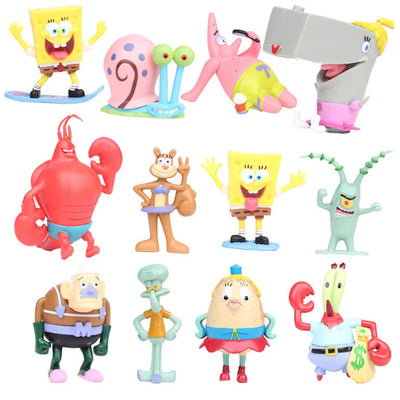
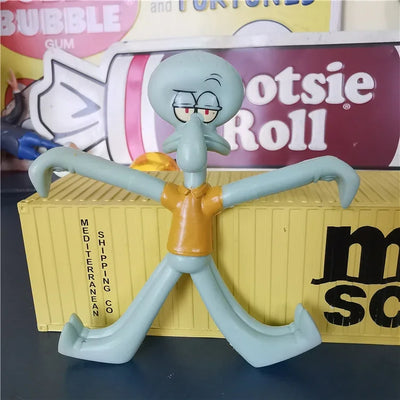
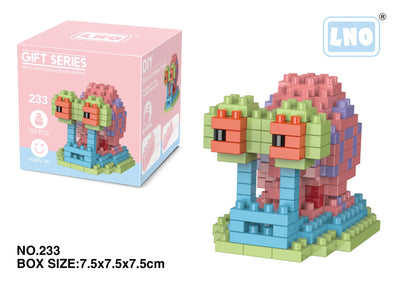
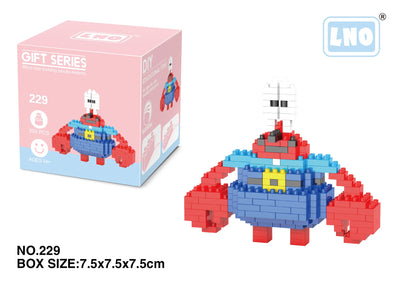
These four models come from our SpongeBob Figures and SpongeBob LEGO collections. Shipping is €5.90 within France and the European Union, free above €60, €7 outside the EU, delivered in 7 to 14 business days. We are an independent fan-run shop: no official link with Nickelodeon or Paramount, and therefore no licensed Mermaid Man figure to offer you.
📺 The show within the show: the key episodes
Mermaid Man and Barnacle Boy sit at the heart of a mini-saga that runs across several seasons of SpongeBob SquarePants. These episodes carry the duo's name followed by a Roman numeral, from I to VI, which makes them one of the few identifiable serials in a show otherwise built from standalone episodes. They are among the favourites of the adult fan community.
The first appearance — SpongeBob and Patrick find their idols in their rest home and talk them into coming back on duty for one mission. The staging of heroic decay is already fully in place from this first outing: the heroes are there, the legend is there, the will to get off the couch much less so.
The kindness-lesson episode — Man Ray, long imprisoned in a block of tartar sauce, regains his freedom and is put through a course in goodness by SpongeBob. The dropped-wallet test, which the villain is supposed to hand back to its owner, is one of the comic peaks of the series. The final twist hangs on very little: forced kindness ends up suiting him rather well.
« Mermaid Man and Barnacle Boy V » — The most meta episode of the saga. Barnacle Boy, fed up with being permanently treated like a child — he is served a kids' meal, he is spoken to like a little boy — switches to the villains' side and joins Man Ray and The Dirty Bubble. The name of their alliance, E.V.I.L., produces one of the most quoted gags in the show, when Patrick misreads it as « Every Villain Is Lemons ». This episode gives Barnacle Boy real psychological depth.
The in-universe TV show — SpongeBob and Patrick are also the audience of their heroes' own television series. They watch it, comment on it, know the lines by heart. A story-within-a-story that shows what a fan who knows the subject better than his idols actually looks like.
We deliberately give no season and episode numbers: the numbering circulating online differs from one broadcast country to another.
🦹 The iconic enemies
Man Ray — Mermaid Man's great villain is a supervillain with a manta ray head. His personality swings between pure malice and a disarming naivety that makes him unintentionally comic. The episode in which SpongeBob tries to teach him goodness is one of the most memorable moments in the whole series.
The Dirty Bubble — A villain who is literally a giant dirty bubble. The complete absurdity of this threat, presented as an existential peril for Bikini Bottom, is the joke in itself. The Dirty Bubble became a cult character precisely because he pushes the « absurd villain » concept to its limit: his only weakness is the weakness of every bubble.
🧭 Why this duo still works
The engine of the duo is simple: it sets two timelines against each other. On one side the official story, the past exploits and the city saved. On the other the wide shot of the rest home, the television left on and two heroes who have forgotten why they stood up.
The gap is never cruel. The show does not mock old age: it mocks the idea that a hero has to stay heroic at all times. Mermaid Man is still respected by all of Bikini Bottom, including when he understands nothing any more. Barnacle Boy keeps his dignity, including when he is handed a kids' meal. The comedy comes from the gap, not from humiliation.
That is also what explains the duo's special place in the show's relationship with nostalgia. SpongeBob is an absolute fan of heroes who belong to a bygone era, exactly as part of the show's audience is now grown up and rewatching its own favourite episodes from twenty years ago. The duo is a mirror held up to the viewer: loving something old also means accepting that this something has aged.
The lair and the signal — The other recurring gag is the lair. The Mermalair is an openly borrowed version of the crimefighter's cave: hidden entrance, central computer, trophy cabinets, a light device meant to call the heroes to the rescue. Except that nothing in it works as intended. SpongeBob and Patrick get lost inside, press the wrong buttons, set off the gadgets at the wrong moment. The lair becomes a playground instead of a command centre, and that is exactly where the episode finds its rhythm.
A confusion worth clearing up — Many fans associate the Magic Conch gag with the duo, that toy shell you pull a string on to get answers. The confusion is understandable: the shell is an object of laughable power, entirely in the spirit of the duo. But the Magic Conch belongs to another storyline in the series, centred on SpongeBob, Patrick and Squidward. On the Mermaid Man side, the shell is the lair's signal, not the plastic oracle.
💫 The cultural impact of the duo
Mermaid Man and Barnacle Boy represent something important in the series: they are proof that SpongeBob SquarePants can handle adult themes — ageing, nostalgia, physical and mental decline, the frustration of no longer being in the spotlight — with humour and tenderness, without ever losing sight of its family audience.
Their presence in the show also makes it possible to explore SpongeBob and Patrick's relationship with their idols. SpongeBob is an absolute fan — he knows every detail of their career, every gadget in their kit, every episode of their television series. That fan devotion, seen from the inside, is both funny and touching. It says something true about what it means to admire someone.
The show's own longevity has caught up with the joke. SpongeBob SquarePants has been in production since 1999, has been renewed through seasons 18 and 19, and now counts four theatrical feature films, released in 2004, 2015, 2020 and December 2025, plus two films shown on Netflix, one devoted to Sandy in August 2024 and the other to Plankton in March 2025. In other words, the show that mocked heroes overtaken by time has itself become a classic passed down across generations.
For the shop's fans, Mermaid Man and Barnacle Boy embody that nostalgic and meta side of the SpongeBob universe — a series that knows how to look at pop culture with affection and critical distance at once.
🎙️ A tribute to the original voices
One particular dimension of Mermaid Man and Barnacle Boy is the story of their voice actors. Ernest Borgnine (Mermaid Man) and Tim Conway (Barnacle Boy) were both leading American performers, known for their roles on television and in film long before Bikini Bottom. Their presence in SpongeBob SquarePants was already a parody in itself: two figures of classic television playing classic superheroes in decline.
Borgnine died in 2012, Conway in 2019. That biographical reality adds a melancholy layer to two characters already defined by the passing of time: the joke about time passing ended up coming true off screen.
We do not name here the performers who may have taken over these roles afterwards. The information circulating on the subject is contradictory depending on the source, and we would rather assert nothing than credit the wrong person. Stephen Hillenburg, the creator of the series, died on 26 November 2018, a year before Tim Conway.
❓ Frequently asked questions
Who are Mermaid Man and Barnacle Boy?
They are two retired undersea superheroes who live at the Shady Shoals rest home in Bikini Bottom. They are the absolute idols of SpongeBob and Patrick. Their dynamic parodies classic superhero duos while exploring themes such as ageing and nostalgia.
What are Mermaid Man and Barnacle Boy a parody of?
They parody the superheroes of the 1960s and 1970s: the undersea crimefighter, of which Aquaman is the best-known figure, and the hero/sidekick pairing of the live-action Batman television series of the late 1960s. The target is that deliberately kitsch television version, with its labelled gadgets and declaimed lines, not the dark modern adaptations of the character.
Which episodes do they appear in?
The duo is at the centre of a run of episodes carrying their name followed by a Roman numeral, from I to VI. They also appear in other episodes as supporting characters, and as the television show that SpongeBob and Patrick watch. We do not quote season and episode numbers: the numbering varies between broadcast countries.
Who are Mermaid Man's enemies?
The main enemies are Man Ray, a supervillain with a manta ray head, and The Dirty Bubble, a giant dirty bubble. Their absurdity sits at the heart of the superhero parody: one is converted by a lesson in kindness, the other has the sturdiness of a soap bubble.
What is the best Mermaid Man episode?
Fan discussions often come back to « Mermaid Man and Barnacle Boy V », the episode in which Barnacle Boy joins the villains to protest at being treated like a child. It is also the most psychologically developed of the episodes devoted to the duo. The episode with the kindness lesson given to Man Ray is the other big favourite.
Why are the original voices no longer the same?
Ernest Borgnine, who voiced Mermaid Man, died in 2012, and Tim Conway, who voiced Barnacle Boy, in 2019. We do not name their possible successors for lack of a reliable source. That biographical reality adds a melancholy dimension to characters already centred on the theme of ageing.