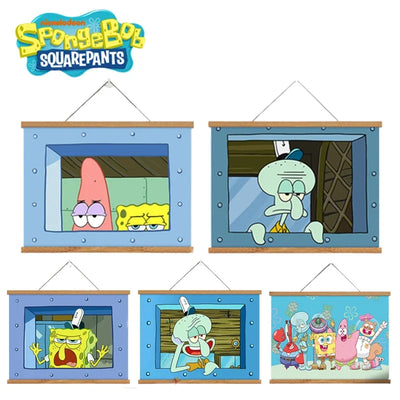
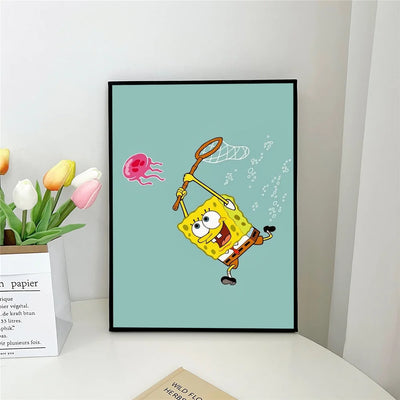
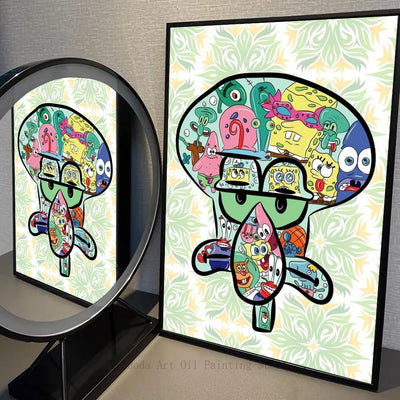
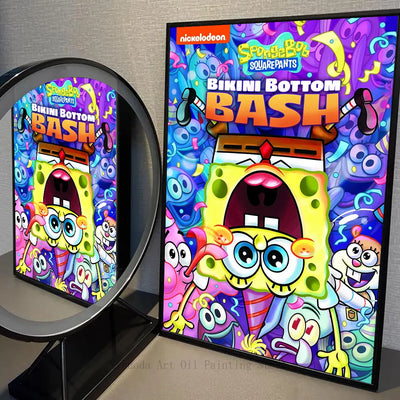
SpongeBob SquarePants was created by Stephen Hillenburg (1961-2018), an American who moved from teaching marine biology to animation and launched the series on Nickelodeon in 1999. He personally ran the first three seasons, stepped down as showrunner to make the first feature film, returned as executive producer in the mid-2010s, and died on 26 November 2018 of amyotrophic lateral sclerosis (ALS), aged 57.
A marine biology teacher turned animator, Hillenburg launched a series in 1999 that is still in production more than twenty-five years later. SpongeBob SquarePants has become a global pop-culture landmark, yet the man behind it remains largely unknown. This guide covers his background, his training and his working method. Every date and fact below is documented: we have deliberately left out the anecdotes that circulate without a source.
🌊 From marine biology to animation
Stephen McDannell Hillenburg was born on 21 August 1961 in Lawton, Oklahoma, on the Fort Sill military base. The family later settled in Southern California, near the ocean.
He studied at Humboldt State University and earned a bachelor's degree in natural resource planning and interpretation in 1984, with an emphasis on marine resources. This nuance is often distorted: it was not a marine biology degree in the strict sense, but a course in managing and interpreting the marine environment. Understanding species and knowing how to explain them to an audience — that profile is exactly what would later shape the way he built a fictional world.
From 1984 to 1987 he taught marine biology at the Orange County Marine Institute in Dana Point, California, now known as the Ocean Institute. He guided school groups and explained tidal zones, tide-pool species and animal behaviour.
For his students he drew an educational comic: The Intertidal Zone. It features anthropomorphic sea creatures, including a narrating sponge named "Bob the Sponge". The comic never found a publisher, but it already contains the principle that would carry the series: let the animals tell the biology themselves.
In 1989 he left teaching and enrolled at the California Institute of the Arts (CalArts) in experimental animation. He earned a Master of Fine Arts there in 1992. His student films are The Green Beret (1991) and Wormholes (1992), a roughly seven-minute short inspired by the theory of relativity. It was Wormholes, screened at the Ottawa International Animation Festival in 1992, that opened the door to television for him.
🎨 Rocko's Modern Life: learning the craft
At Ottawa, Hillenburg met Joe Murray, the creator of Rocko's Modern Life, who hired him onto the show. From 1993 to 1996 he held several roles in turn: storyboard artist, writer, director, executive story editor. In 1995 he became its creative director.
This is where he learned the language of animated television comedy: gag construction, timing, the constraints of a weekly series. Rocko's Modern Life was already an offbeat show, with layers of adult reading under a surface accessible to children — exactly the register SpongeBob would push further.
He also met the people who would matter later. Derek Drymon, future creative director on SpongeBob, came from Rocko. Tom Kenny, who would voice the title character in the original version, also worked there as a voice actor.
In parallel, from 1994 onward, Hillenburg developed his own project in his sketchbooks. The hero was first called SpongeBoy. The name was dropped because it was already registered as a trademark for a household cleaning product. SpongeBoy became SpongeBob.
To carry on the world he created
Four prints from our Posters collection, inspired by the characters and settings of Bikini Bottom.


The full range is on our SpongeBob Posters page. Shipping €5.90 to France and the EU, free over €60, €7 outside the EU, 7 to 14 business days. Independent shop, not affiliated with Nickelodeon or Paramount.
🟡 The birth of SpongeBob SquarePants (1999)
In 1997 Hillenburg pitched the project to Nickelodeon. The presentation became famous in the industry: a Hawaiian shirt, Hawaiian music, and above all a terrarium recreating the sea floor with character models placed inside it. Rather than showing a concept on paper, he walked the network into the set.
Nickelodeon ordered the series. A preview aired on 1 May 1999, following the Kids' Choice Awards ceremony. The regular launch took place on 17 July 1999: SpongeBob became the network's first original Saturday-morning cartoon.
One correction, because the error keeps circulating online: the series was not launched on the day Star Wars: Episode I - The Phantom Menace opened. That film was released in the United States on 19 May 1999, nearly three weeks after the SpongeBob preview.
What set the show apart immediately was its tone. It works for children and for the adults watching with them: two levels of reading calibrated within the same scene. Hillenburg openly claimed two very different lineages — the cartoons of Tex Avery and Chuck Jones on one side, the underwater documentaries of Jacques Cousteau on the other. The Cousteau tribute is explicit in the French-accented narrator who opens many episodes in the original version.
🗓️ Timeline
| Year | Milestone | What it changed |
|---|---|---|
| 1961 | Born on 21 August in Lawton, Oklahoma | The family later settled in Southern California, near the ocean |
| 1984 | Bachelor's degree at Humboldt State University, marine resources emphasis | He approached the marine world as a science interpreter, not an illustrator |
| 1984-1987 | Taught marine biology at the Orange County Marine Institute, Dana Point | He drew The Intertidal Zone there, featuring a narrating sponge |
| 1989 | Enrolled at the California Institute of the Arts in experimental animation | A deliberate career change at 28 |
| 1992 | Master of Fine Arts; thesis film Wormholes | Screened at the Ottawa festival, where he met Joe Murray |
| 1993-1996 | Rocko's Modern Life on Nickelodeon | Storyboards, writing, directing, then creative director in 1995 |
| 1994 | Began developing SpongeBob | The name SpongeBoy was dropped, already a registered trademark |
| 1997 | Pitched the project to Nickelodeon with a terrarium and character models | The series was ordered |
| 1999 | Preview on 1 May, regular launch on 17 July | Nickelodeon's first original Saturday-morning cartoon |
| 2002 | Stepped down as showrunner after season 3 | Paul Tibbitt succeeded him; Hillenburg stayed on as executive producer |
| 2004 | Release of The SpongeBob SquarePants Movie | He had conceived it as a conclusion; the series continued without him |
| 2014-2015 | Announced his return to the series; co-writer of Sponge Out of Water | He took an active role again for the rest of his life |
| March 2017 | Publicly announced he had amyotrophic lateral sclerosis (ALS) | He said he intended to keep working as long as he could |
| 2018 | Died on 26 November, aged 57, at his home in San Marino, California | His ashes were scattered in the Pacific |
| 2021 | Launch of Kamp Koral and The Patrick Star Show | Spin-offs released after his death; he is credited as character creator |
🔬 What his scientific training actually brought to the show
Hillenburg's past as a science interpreter shows up in almost every design decision on the series.
The cast is a species survey. SpongeBob is a sponge, Patrick a sea star, Mrs. Puff a pufferfish, Mr. Krabs a crab, Pearl a whale, Gary a sea snail, Plankton a copepod — which is what justifies his microscopic size and every gag that follows from it. The choice is never decorative: each species brings a constraint, and the constraint manufactures the comedy.
Real behaviour becomes a writing device. A pufferfish inflates when stressed: that is a documented defence mechanism, and it is also the running gag with Mrs. Puff every time SpongeBob takes the wheel. Sea stars have a very simple nervous system with no centralised brain: Patrick is the comic translation of that. Sponges filter water and are porous, which supplies an endless reserve of physical gags.
The exceptions are owned, not hidden. Sandy Cheeks is a land mammal: the show gives her an air-filled dome and a diving suit, and respects that constraint from episode to episode. Squidward's name points to a squid, but he is drawn as an octopus with only six tentacles — an acknowledged graphic compromise. Pearl is a whale born to a crab: the absurdity works precisely because everything around it is literal.
The vocabulary comes from the field. Jellyfishing, tide pools, atolls: the very name Bikini Bottom refers to Bikini Atoll in the Pacific. And the hero's shape is a documented design decision: Hillenburg first drew a natural sponge, round and irregular, before choosing the rectangular kitchen sponge as clearer and funnier on screen.
What it is not. Hillenburg was not making a disguised science lesson. Biology is never the moral of the episode: it works as a stable base so that the absurd has something to push against. That underlying consistency is why the same episode works at six and at forty.
🎬 Leaving after the film, then coming back
The show's success created lasting tension with the network, which wanted more episodes and more spin-offs, while Hillenburg wanted a pace compatible with the quality he was aiming for.
He stepped down as showrunner after season 3, in 2002, to focus on the feature film. Paul Tibbitt took over running production; Hillenburg kept an executive producer credit. The SpongeBob SquarePants Movie was released in November 2004, and he had conceived it as the conclusion of the series. Nickelodeon did not stop there: season 4 launched in 2005 without him in charge.
The change was concrete. On seasons 1 to 3, Hillenburg was the final arbiter of every storyboard; from season 4 onward he became a consulted producer, which is not the same decision-making power. Part of the audience places a shift in the show's tone at that point: that is a matter of judgement, not a measurable fact. The detail is covered in our season-by-season guide.
He announced his return to the series in 2014, then co-wrote and produced The SpongeBob Movie: Sponge Out of Water, released in 2015. He remained credited as executive producer until his death. The three films released in 2004, 2015 and 2020 frame those three phases quite well: the ending he had imagined, the return, then the aftermath.
📐 His method and working principles
Writing through the storyboard. SpongeBob is not written like a sitcom. An episode starts from a short premise, then two artists build it directly on the storyboard, dialogue included. The artist is an author, not an executor. Hillenburg had seen the model work on Rocko's Modern Life and put it at the heart of his own production; it is one reason American television animation in the 2000s hired so many storyboard-writers.
The gag must read without sound. He insisted that the humour work visually first: a scene stripped of dialogue had to stay understandable and funny. That requirement is inherited from the cartoons of the 1940s and 1950s.
Emotional honesty. The characters have sincere emotions, even in absurd situations. SpongeBob is genuinely enthusiastic, Patrick genuinely naive, Squidward genuinely exasperated. That emotional seriousness is what makes them likeable beyond the gag.
A refusal of cynicism. SpongeBob's kindness is never presented as a weakness to be corrected. In a late-1990s television landscape largely dominated by ironic humour, that was a choice against the grain.
🎗️ Illness and death
In March 2017, Stephen Hillenburg publicly announced, in a statement to Variety, that he had amyotrophic lateral sclerosis (ALS). This neurodegenerative disease progressively affects the motor neurons. There is no curative treatment. In his statement he said he wanted to keep working on the series as long as he was able.
He stayed involved with production to the end. Stephen Hillenburg died on 26 November 2018, aged 57, at his home in San Marino, California. His ashes were scattered in the Pacific Ocean. His death prompted tributes around the world from fellow animators, voice actors and cultural institutions.
He is survived by his wife, the chef Karen Umland, whom he married in 1998, and their son Clay. One detail says a good deal about her place in his work: Karen, the computer who stands up to Plankton, was named after her.
🏆 What he left behind
In industrial terms the legacy is easy to measure. The series is still in production more than twenty-five years after its launch. Three feature films have been released, in 2004, 2015 and 2020. Two spin-offs, Kamp Koral and The Patrick Star Show, launched in 2021, after his death; he is credited on them as character creator.
Those spin-offs are in fact the most discussed friction point in his legacy. Paul Tibbitt, who had succeeded him as showrunner, reported after his death that Hillenburg regularly joked that the day anyone asked him for a "SpongeBob Babies" would be the day he walked out. That is a second-hand account, not a position Hillenburg published himself, and it should be read as such — but it does shed light on how he viewed prequels. We cover the subject in our article on Kamp Koral and the spin-offs.
Artistically, seasons 1 to 3, made under his direct supervision, are the benchmark a large part of the audience and of critics return to. That is a widely shared judgement, not a measured figure.
🌟 What his path can teach
Hillenburg did not abandon his first skill when he changed careers: he reused it. Three years spent explaining tide pools to school groups gave him two things no animation school provides — a stock of raw material, and the habit of making a complex subject readable in a few minutes. He did not create SpongeBob to fill a commercial slot, but to make a series that resembled him: curious, optimistic, well documented. To dig into the world itself, start with our profile of the SpongeBob character or the guide to the landmarks of Bikini Bottom.
❓ Frequently asked questions
Who created SpongeBob SquarePants?
SpongeBob SquarePants was created by Stephen Hillenburg (1961-2018). He first taught marine biology at the Orange County Marine Institute in Dana Point, California, from 1984 to 1987, then studied animation at the California Institute of the Arts, where he earned a Master of Fine Arts in 1992. Nickelodeon ordered the series after a pitch in 1997.
What did Stephen Hillenburg die of?
He died on 26 November 2018, aged 57, from amyotrophic lateral sclerosis (ALS), a neurodegenerative disease also known as motor neurone disease. He publicly announced his diagnosis in March 2017 and said he intended to keep working as long as possible.
Is SpongeBob based on a real person?
No, the character is not a portrait of an existing person. His first appearance is a narrating sponge, "Bob the Sponge", drawn by Hillenburg in an educational comic titled The Intertidal Zone during his teaching years. One character in the series does carry a real person's name, however: Karen, Plankton's computer, was named after Karen Umland, Hillenburg's wife.
When did the first SpongeBob episode air?
A preview aired on 1 May 1999 on Nickelodeon, following the Kids' Choice Awards, and the regular launch took place on 17 July 1999. Contrary to what is often written, that was not the day Star Wars: Episode I opened; that film was released in the United States on 19 May 1999.
Why did Stephen Hillenburg leave the series, and when did he return?
He stepped down as showrunner after season 3, in 2002, to make the feature film released in 2004, which he saw as the conclusion of the series. Paul Tibbitt took over running production and Hillenburg remained executive producer. He announced his return in 2014, co-wrote the 2015 film, and stayed involved until his death.
Was Hillenburg really a marine biologist?
He taught marine biology for three years, but the degree he earned in 1984 at Humboldt State University was in natural resource planning and interpretation, with an emphasis on marine resources. So he was a marine environment professional and a science interpreter rather than a research biologist in the academic sense.
Did he work on Kamp Koral and The Patrick Star Show?
No. Both spin-offs launched in 2021, after his death in 2018. He appears in the credits as character creator, which is an originating credit rather than involvement in writing them.
What was his thesis film?
Wormholes, a roughly seven-minute short inspired by the theory of relativity, completed in 1992. He had previously made The Green Beret in 1991. It was the screening of Wormholes at the Ottawa International Animation Festival that let him meet Joe Murray and join Rocko's Modern Life.