The iconic places of Bikini Bottom are the Krusty Krab, the Chum Bucket, SpongeBob's pineapple house, Patrick's rock, Squidward Tentacles' Easter Island head, Mrs. Puff's Boating School, Jellyfish Fields, Sandy's Treedome and Goo Lagoon beach. These nine settings appear in almost every episode, while the rest of the town — mall, museum, hospital, jail — shows up whenever a script needs it.
Bikini Bottom is one of the most recognisable fictional towns in popular culture. Since 1999, its streets, buildings and landscapes have become as familiar to millions of viewers as their own neighbourhood. Behind the colourful sets there is real worldbuilding: every place has a narrative function and a precise slot in the show's ecosystem. This guide walks through the essential locations of Bikini Bottom.
A word about names. The French and German dubs renamed most of these places, and not always consistently from one season to the next. This guide uses the original English names, which are the ones fans search for, and gives the dub names in the table below. Our page the places of Bikini Bottom covers the same list as short entries.
🍔 The Krusty Krab: the central location of the show
The Krusty Krab is the most used setting in the series. It is where SpongeBob works as a fry cook, where the residents of Bikini Bottom come to eat the Krabby Patty, and where most of the plots are set in motion.
The design — The building is shaped like a lobster trap, complete with wooden slats, buoys and a sign above the door. Stephen Hillenburg was a marine biologist and a marine science teacher before he created the show: the fishing gear is reproduced accurately.
What is interpretation — Many fans read a metaphor into that choice: a lobster trap lures lobsters with food, just as Mr. Krabs lures customers in to take their money. It is an appealing reading, but the show never states it and it cannot be traced to any sourced statement. File it under interpretation, not canon.
The kitchen — The grill station is the space most strongly tied to the character. It is where SpongeBob shows his skill and his attachment to his job. The spatula he uses works as a character attribute, much like his red tie. Many episodes explore his relationship with that space.
Mr. Krabs' office — Small, cluttered, with a safe on display, the office reflects the owner's personality. He spends more time counting his money than running his restaurant. It is also the space for confrontations with Plankton and for pay negotiations that SpongeBob always loses.
The temporary makeovers — Across the seasons the restaurant changes identity for the length of an episode: Krusty Towers turns it into a luxury hotel, and Krabby O'Monday's into a fast-food franchise. These variations push Mr. Krabs' business ambitions to their absurd conclusion.
🧪 The Chum Bucket: the rival across the road
Directly opposite the Krusty Krab stands the restaurant run by Plankton and Karen. The name is literal: a bucket of chum, the bait made from fish waste. The French dub calls it « le Seau de l'Enfer » and the German dub « Abfalleimer »; the wording « l'Antre du Crabe », which circulates on several French websites, matches no name used in the show.
A design built on contrast — The building is a giant dark metal bucket set at the roadside. The visual contrast with the wooden lobster trap across the street is immediate: wood and red on one side, grey metal on the other. Where the Krusty Krab is full, the Chum Bucket is empty.
Plankton's lab — Behind the dining room lies Plankton's real domain: a fully equipped laboratory where he works out his schemes to steal the secret Krabby Patty formula. Gadgets, robots and evil machines are all built there. It is also where Karen, his computer wife, sits as a wall-mounted screen.
The food — The Chum Bucket serves chum, which explains the absence of customers. That permanent commercial failure drives the rivalry with Mr. Krabs. Plankton never manages to dislodge his neighbour, and that repeated defeat is part of the show's comic contract.
To bring Bikini Bottom home
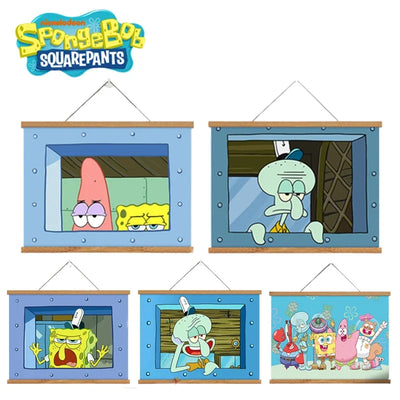
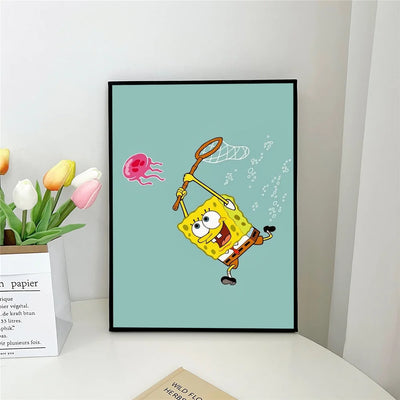
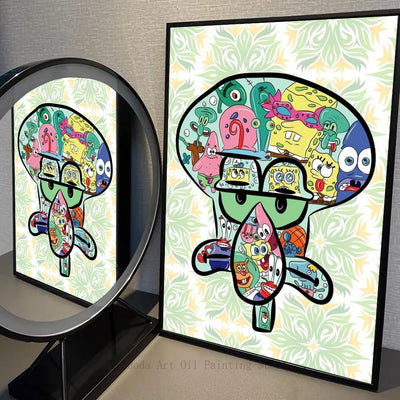
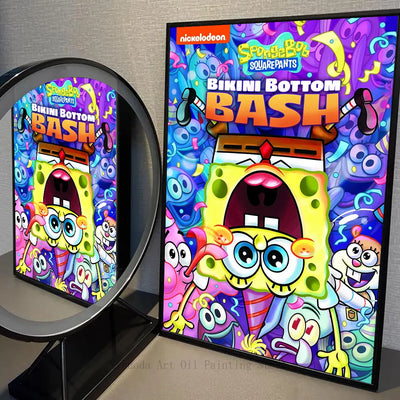
Four items from the shop that pick up the places and residents this article talks about 🌊


The rest of the decor range sits in the SpongeBob LEGO, SpongeBob Lamps, SpongeBob Figures and SpongeBob Posters collections. Shipping is €5.90 in France and the European Union, free from €60, €7 outside the EU, within 7 to 14 business days. We are an independent fan-run shop with no connection to Nickelodeon or Paramount.
🏠 SpongeBob's pineapple house
SpongeBob's house is one of the most recognisable designs in the series. A giant pineapple with windows and a door: absurd, identifiable at a glance, and consistent with the show's marine world.
Why a pineapple? No single official explanation has ever been published. The story of a pineapple falling off a cargo ship and being colonised on the seabed circulates everywhere and is often credited to Stephen Hillenburg with no verifiable source: it is a fan reconstruction. What is visible on screen, on the other hand, is clear: Bikini Bottom is saturated with tiki and Polynesian motifs — the pineapple, Squidward's Easter Island head, the bamboo, the masks — consistent with a town said to sit in the Pacific.
The interior — The inside is warm, colourful, slightly cluttered. There is a living room with his armchair, a kitchen, a bathroom, a bedroom upstairs and Gary's corner. The foghorn alarm clock that gets SpongeBob out of bed is a recurring opening gag. Episodes set in this house often have a more intimate tone.
Jellyfish at home — Jellyfishing is a recurring hobby for the characters, and SpongeBob sometimes brings jellyfish home. A jellyfish tank appears in some episodes, not in all of them: it is not a permanent part of the set.
🪨 Patrick's rock
Patrick Star lives under a flat rock resting on the seabed, the most minimalist home in the series. From the outside it is an ordinary rock. From the inside it is also more or less an ordinary rock.
The design — Patrick's home mirrors his personality. Where SpongeBob's is full of objects, Patrick's is empty: an armchair, sometimes a television set, sometimes nothing. Recurring gags play on the rock blending into the scenery, or on Patrick sleeping straight on the floor.
What varies — The inside of the rock is not stable from one episode to the next: sometimes completely bare, sometimes furnished, sometimes far larger than the rock suggests. It is the clearest example in the whole series of a set that bends to the needs of a gag. The rock itself never changes.
🏡 Squidward Tentacles' house
Squidward lives in a house shaped like a moai, one of the monumental statues of Easter Island. The choice fits his personality: obsessed with art and with his own importance, he lives in a building that presents itself as a sculpture.
The interior — The inside is dominated by portraits of Squidward painted by Squidward. An easel is often visible, and his clarinet is never far away: it is his instrument throughout the series, and the source of much of the neighbourhood's noise pollution.
The location — The three houses stand in a row on the same street, Conch Street, whose name appears on the signs. Squidward's is wedged between SpongeBob's pineapple and Patrick's rock. Despite his efforts to live in peace, he is interrupted by his two neighbours roughly every week.
🏫 Mrs. Puff's Boating School
Mrs. Puff's school teaches boat driving, not car driving. It is one of the most used secondary locations. SpongeBob has been taking lessons there for years without ever holding on to a boating licence.
The symbol of repeated failure — SpongeBob is a good cook, a loyal friend and a zealous employee, but he cannot drive a boat without causing a disaster. That specific inability, replayed in the same setting, powers a comic mechanism the show uses across every season.
The teacher-pupil relationship — The relationship between Mrs. Puff and SpongeBob is one of the most ambivalent in the series: she dreads every one of his lessons, he genuinely admires her. The episodes never state a rule that would forbid expelling him; the often-repeated explanation that « the law prevents her » does not appear in the show. They simply end up there, episode after episode.
🎣 Jellyfish Fields
Jellyfish Fields is the natural setting of Bikini Bottom: a wide underwater meadow full of colourful jellyfish, where SpongeBob and Patrick come to catch them with nets. It is the space of play and friendship.
The narrative role — Unlike the domestic and professional spaces that structure most of the series, Jellyfish Fields stands for free time. Episodes set there usually have a lighter tone. It is also one of the few settings where no character holds authority over the others.
The jellyfish — Two things are constant on screen: jellyfish sting, and the sting is drawn as an electric shock; and jellyfish jelly is used like jam, including on Krabby Patties. This pseudo-scientific ecosystem is typical of the show's humour.
🌳 Sandy's Treedome
Sandy Cheeks comes from Texas. She does not breathe underwater, so she lives in an air-filled glass dome planted in the middle of Bikini Bottom. Inside: a tree with a door, an exercise wheel, grass, and a blue sky.
The place where the logic flips — When SpongeBob and Patrick step into the dome, they have to wear water-filled helmets to survive. The gag rests on that reversal: the only dangerous spot in town is the one that looks most like the surface world. It is also Sandy's laboratory, and the starting point of most of the science-driven plots.
📋 The table of Bikini Bottom locations
| English name | French and German dub names | Who lives or works there | What it looks like | Role in the show |
|---|---|---|---|---|
| Krusty Krab | Le Crabe Croustillant / Krosse Krabbe | Mr. Krabs, SpongeBob, Squidward Tentacles | A wooden lobster trap with buoys and a sign | Main setting, workplace and home of the secret formula |
| Chum Bucket | Le Seau de l'Enfer / Abfalleimer | Plankton and Karen | A giant dark metal bucket, opposite the Krusty Krab | Rival restaurant with no customers, base of Plankton's schemes |
| The pineapple house | La maison ananas / Das Ananashaus | SpongeBob and Gary | A giant pineapple with windows and a door | The hero's home, setting for the intimate episodes |
| Patrick's rock | Le rocher de Patrick / Patricks Stein | Patrick Star | A flat rock that lifts like a lid | Permanent visual gag, interior varies by episode |
| Squidward's Easter Island head | La maison de Carlo Tentacule / Thaddäus' Osterinsel-Kopf | Squidward Tentacles | A moai head from Easter Island | The neighbour stuck between his two noisy neighbours |
| Mrs. Puff's Boating School | L'école de conduite de Madame Puff / Fräulein Puffs Bootsfahrschule | Mrs. Puff, with SpongeBob as her pupil | A small school building and a practice ground | The site of endless failure at the boating licence |
| Jellyfish Fields | La prairie aux méduses / Quallenfelder | The jellyfish; SpongeBob and Patrick pass through | An underwater meadow of coral and jellyfish | Leisure space, away from town and work |
| Sandy's Treedome | Le dôme de Sandy / Sandys Baumkuppel | Sandy Cheeks | An air-filled glass dome with a tree at its centre | The show's laboratory, where the logic flips |
| Goo Lagoon | Goo Lagoon (name usually kept in both dubs) | Larry the Lobster and all of Bikini Bottom in summer | A sandy beach at the bottom of the sea, with waves | Social setting of the beach and swimming episodes |
| Conch Street | La rue de Conch / Schneckengasse | SpongeBob, Patrick and Squidward Tentacles | A suburban street with three houses in a row | The only truly stable geographical landmark in town |
🏙️ The town of Bikini Bottom: the urban space
Beyond the iconic locations, Bikini Bottom works like a real town, with its shops and its institutions. The most attentive fans enjoy its inconsistencies from one episode to the next.
Goo Lagoon — The beach of Bikini Bottom is Goo Lagoon, a sandy beach at the bottom of the sea where residents go swimming even though they are already underwater. The absurdity is deliberate. It is a recurring summer meeting place, and Larry the Lobster's playground.
The museum, the mall, the jail — Bikini Bottom has the facilities of a mid-sized town. These spaces serve as backdrops for themed episodes: the museum for culture stories, the mall for consumer stories, the jail for Plankton's many arrests.
🗺️ The geography of Bikini Bottom: what stays, what shifts
What never changes. Four spatial relationships hold across the whole series. The three houses stand in a row on Conch Street, in the same order: the pineapple, the Easter Island head, the rock. The Krusty Krab and the Chum Bucket face each other across the road. Jellyfish Fields lies outside town, never downtown. Sandy's Treedome sits apart from the urban fabric.
What shifts with the needs of the script. Distances are elastic: SpongeBob walks to work, takes a bus, or gets there in seconds depending on the episode. The number of buildings varies, and so does the interior size of the Krusty Krab. Places appear for a single episode and then vanish. No map is treated as canon by the series: the layouts found in video games and merchandise do not match each other.
Why an American suburb. Bikini Bottom is not built like an undersea city but like a United States suburb transposed to the seabed. Detached houses with lawns, mailboxes, cars that are boats, a shopping mall, a licence to pass, an hourly wage, a stingy boss: the setting is that of ordinary working life. All the comedy comes from that mismatch, not from escapism. Viewers recognise their own street, in yellow and bubbles.
Bikini Atoll: what the show does with it. Bikini Atoll is a real place, in the Marshall Islands, in the northern Pacific. Twenty-three United States nuclear tests were carried out there between 1946 and 1958, and its population was displaced. The name Bikini Bottom plays on that atoll and on the word « bottom ». The show therefore borrows the name and the Pacific location, and nothing more.
What the show does not do with it. No episode deals with the nuclear tests. The widespread theory that the residents of Bikini Bottom are irradiated mutants is a fan theory: it has never been confirmed by the creators and nothing on screen establishes it. It is fun to read, but it is not canon. We cover it at greater length in the wildest fan theories about SpongeBob.
❓ Frequently asked questions
Where is Bikini Bottom located?
Bikini Bottom sits at the bottom of the Pacific Ocean, beneath Bikini Atoll in the Marshall Islands. That is where its name comes from. The show never gives more precise coordinates, and its internal geography varies from one episode to the next.
What is SpongeBob's house called?
It has no proper name: everyone simply calls it the pineapple house, or SpongeBob's pineapple. Its address, on the other hand, is given on screen: 124 Conch Street.
Does Bikini Bottom really exist?
No, the town is entirely fictional. Bikini Atoll, whose name it borrows, does exist, in the Marshall Islands. So you can visit the atoll, but you will find neither a Krusty Krab nor a pineapple house there.
Why is SpongeBob's house a pineapple?
There is no single official explanation. The story of the pineapple falling off a cargo ship is a fan reconstruction, often credited to Stephen Hillenburg without a source. What is constant is the tiki and tropical aesthetic of the whole town, of which the pineapple is one part alongside Squidward's Easter Island head.
Why is the Krusty Krab a lobster trap?
The building reproduces a real piece of fishing gear, which fits Stephen Hillenburg's training as a marine biologist. The metaphorical reading — the trap lures lobsters just as Mr. Krabs lures customers — is a fan interpretation, not a documented intention.
Why is Squidward's house shaped like a moai?
Moai are the monumental statues of Easter Island. The choice matches Squidward's personality as a frustrated artist very attached to his own importance, and fits the general tiki aesthetic of Bikini Bottom.
Is there an official map of Bikini Bottom?
No. Layouts exist in video games and merchandise, but they do not match each other and the series treats none of them as canon. Only a few neighbourhood relationships are stable, such as the order of the three houses on Conch Street.